LOVE AT SECOND SIP
a Pondicherry romance of second chances
Love at Second Sip
She Was Afraid of Being Left. She Was Afraid to Stay.
How Maya and Leah became the heart of Love at Second Sip.
Two people can want love just as badly and still be frightened of completely different things.
That thought stayed with me for a very long time before Love at Second Sip became a book. What happens when two people who have spent their lives protecting themselves finally meet someone worth the risk? Maya and Leah were my answer, and they arrived carrying opposite fears.
Maya Kapoor came first. I found her behind the counter of Second Sip Café, wiping a surface that was already clean. Her hair is tied back so tightly that not a strand dares move. Her chairs go up in lines, never circles. She counts the till twice because twice has saved her before. Every evening she touches the old bell last, the way her father used to. None of this is fussiness. It is architecture. Maya has built a life where nothing can surprise her, because she knows what it costs when people leave.
Leah Fernandes is the storm that walks through that architecture, quite literally, on a rain-soaked night, dripping onto floors Maya has just dried. She is a photographer who lives out of a suitcase that knows her name. She notices everything: the old scar on Maya’s elbow, the way she holds her cleaning cloth like a weapon. But Leah’s freedom has a shadow. Her rule is simple: “I leave first so nobody can tell me I overstayed my welcome.”
As I wrote them, I realised I was not really writing about opposites attracting. I was writing about two different kinds of armour. Maya’s armour is control: if she never asks anyone to stay, no one can refuse her. Leah’s armour is distance: if she is always the one leaving, she never has to watch anyone go.
Put those two women in one small café in Pondicherry and something has to give. Every cup of coffee becomes a negotiation. Every honest sentence costs them something.
That is why they belonged in the same story. Each one holds up a mirror to the other’s fear. Maya shows Leah what her leaving does to the people left behind. Leah shows Maya how small she has made her world in order to feel safe.
I don’t think love fixes our fears. I think the right person makes us brave enough to look at them. That is what Maya and Leah do for each other.
If you have ever loved cautiously or trusted reluctantly, you will recognise them both.
Love at Second Sip is available now — buy a signed copy.
↑ Back to top
Love at Second Sip
Tu Hi Ghar: Why I Gave My Novel Its Own Song
The story behind the original song from Love at Second Sip.
Some stories arrive as scenes. Some arrive as sentences. This one eventually asked for a song.
Love at Second Sip is a quiet book in many ways. So much of it lives in small moments: steam curling into lantern light, rain against the shutters, two women sitting a little closer than they meant to. Somewhere while writing it, I realised the story had a sound. Not a loud one. Something closer to a hum, the feeling you carry home after a long evening with someone you love.
That feeling became “Tu Hi Ghar.”
The title means, roughly, “you are home,” and it holds the idea at the centre of the whole novel: sometimes home isn’t a place at all.
Maya has a place. She has Second Sip, the blue walls of her flat upstairs, the bell her father used to touch at closing time. Leah has the opposite: a camera, a motorbike, a suitcase and a lifetime of next cities. One woman is rooted to a building; the other refuses roots altogether. And yet neither of them is truly at home.
What they discover, slowly and not without cost, is that home can be another person. Not someone who completes you, but someone who makes it safe to stop running, or to stop hiding.
I wanted readers to feel that, not only read it. Music reaches places prose sometimes can’t. A song can hold longing and comfort in the same breath, which is exactly what Maya and Leah do for each other. That is why the book opens with an invitation: before you turn the page, or after you reach the end, scan the QR code and let the music accompany the story.
If you listen while you read, I hope it feels like the last cup of coffee before the café closes: warm, unhurried and a little bittersweet.
“Tu Hi Ghar” — the original song written for Love at Second Sip.
If the song stays with you, Maya and Leah’s story is waiting in Love at Second Sip — available here.
↑ Back to top
Love at Second Sip
Pondicherry for People Who Like Slow Mornings, Old Streets and Stories
A bookish journey through the atmosphere behind Love at Second Sip.
There are cities you visit, and there are cities that make you want to stay long enough for something to happen to you.
Pondicherry is the second kind. It doesn’t hurry you. It doesn’t perform for you. It waits, and if you let it, it changes the speed of your heart.
That is why Love at Second Sip could never have been set anywhere else. I needed a city that knew how to move slowly, one that could hold grief and joy at the same time without asking either to leave. A city where two guarded women might, over enough cups of coffee, forget to keep their guard up.
Start with the mornings. Shutters creak open onto lanes still glistening from last night’s rain. Bougainvillea petals lie scattered across the stones as if someone dropped them on purpose. Somewhere a kitchen is already awake: batter hissing on the tawa, curry leaves crackling in hot ghee, filter coffee dripping slowly into its steel pot.
Then the café fills, and Pondicherry’s real music begins. English over Tamil over French over the clatter of steel tumblers. Aunty Latha at her window seat with jasmine in her braid and the horoscope page open. Scooters honking at one another like birds. Salt from the Bay drifting in through the propped-open door.
Walk out in the evening and the light turns gold and rose over rooftops and church spires, lingering as though it isn’t ready to leave either. On the Promenade, waves break against the rocks below. Families stroll, children race each other, vendors sell roasted peanuts and ice cream. In the novel, this is where Maya sits sideways on a low wall and, for once, isn’t in a hurry to return to anything.
And the nights belong to lanterns. A single lantern is burning in Second Sip on the stormy night Leah first walks in. Lantern light softens everything that follows: the café, the women in it, and the things they finally say aloud.
If you go looking for Second Sip, you won’t find it on a map. But you will find its feeling in a hundred corners of Pondicherry, if you sit still long enough.
So go slowly. Order a second cup. Let the sea wind do the rest.
Then come and meet Maya and Leah in Love at Second Sip — available here.
↑ Back to top
Love at Second Sip
Why Do We Run From the Love We Want?
The emotional contradiction behind Maya and Leah.
Sometimes the person asking you to stay is terrified you will leave. Sometimes the person leaving is terrified that staying will matter too much.
We say we want closeness, and we mean it. And yet, when it finally arrives, so many of us find a reason to step back. We get busy. We get guarded. We pick a fight we don’t believe in. We leave before we can be left.
I think it is because closeness is never free. To be truly known, you have to let someone see the parts of you that have been hurt before. And once you have been hurt, every new person looks a little like a risk.
Maya and Leah are my way into this question.
Maya protects herself by never asking. Her café runs on routine; her feelings run on restraint. She has survived loss by becoming quiet and self-sufficient, and by deciding in advance that people will eventually go. If she never asks anyone to stay, she can never be refused.
Leah protects herself by moving. She is generous, funny, impossible to ignore, and always halfway out the door. “I leave first,” she admits, “so nobody can tell me I overstayed my welcome.” For years she believed that leaving early kept everyone safe, including the people she cared about.
What I love about them is that neither is wrong about the danger. Love can hurt. People do leave. The mistake isn’t seeing the risk. It is believing that running from it actually protects you. Maya’s carefulness doesn’t keep loss away; it only keeps joy out too. Leah’s leaving doesn’t make her harmless; it makes her someone people miss.
There is a moment in the book when Leah realises exactly that: her absence has weight, and she is “not harmless here.” It is one of my favourite turns in the story, because it is the moment running stops being a reflex and becomes a choice.
Second chances rarely arrive as grand gestures. They are built quietly, through honest conversations, through forgiveness, through showing up again after disappointment. Through choosing someone, and allowing yourself to be chosen in return.
If you recognise yourself in Maya’s caution or Leah’s restlessness, you are not broken. You are protecting something precious. The only question is whether you are ready to let someone help you hold it.
Maya and Leah’s story is in Love at Second Sip — available here.
↑ Back to top
3:17
a Mumbai horror of the hour after three
3:17
What If Your Phone Knew What You Did at 3:17 A.M. — But You Didn’t?
When technology becomes the new haunted house.
The frightening thing about a haunted phone is that you cannot simply leave it behind. Your life is already inside it.
Horror has always lived in houses: creaking staircases, locked attics, a mansion at the end of a long road. The comfort of those stories is that you can imagine turning the car around. You can choose not to go in.
But what about the thing you carry everywhere? The thing that sleeps beside your pillow and knows your face, your location, your bank details, your mother’s voice notes and the old chat you never deleted?
That question is where 3:17 began. One sleepless night, staring at the time glowing on my phone, a thought arrived: what if your phone knew something you didn’t?
Alina D’Souza, the woman at the centre of the novel, is a social media executive. Her whole life runs through screens. She writes captions meant to sound spontaneous and schedules posts that pretend not to be scheduled. Every night she promises herself she will stop scrolling before bed, and every night she fails. In other words, she is most of us.
Then, one night, she wakes up with her phone already in her hand. WhatsApp is open, not to a friend, but to a chat titled “Me.” Her own number. Her own display picture. And one message waiting:
You should wake up.
Delivered 3:17 A.M.
What unsettles me about technology isn’t that it might be evil. It’s that we trust it completely. We trust timestamps. We trust photographs. We trust “last seen” and two blue ticks. Our devices have become the official record of who we are and where we were. So what happens when that record starts to disagree with you? When a photograph returns to your gallery after you have deleted it? When a message shows as read at 3:13, three minutes before it was sent?
That is the haunting in 3:17. Not a ghost rattling chains, but a slow, quiet erosion of certainty, with the evidence of your own life turning against you.
Next time you reach for your phone in the dark, notice how much of yourself you have handed to it without a second thought.
● Coming soon
3:17 is coming soon. Until then, maybe charge your phone on the other side of the room tonight.
↑ Back to top
3:17
Why I Didn’t Want the Woman in My Horror Novel to Be a Hero
Writing Alina D’Souza as someone ordinary.
I didn’t want Alina to walk into Apartment 504 looking prepared for a horror story. I wanted her to look like someone who had groceries to buy and messages to answer.
So many horror heroines are built for the fight. They are investigators, sceptics with something to prove, people who go looking for the dark. I understand the appeal. But when I sat down to write my first horror novel, I wanted the opposite. I wanted someone who could be you.
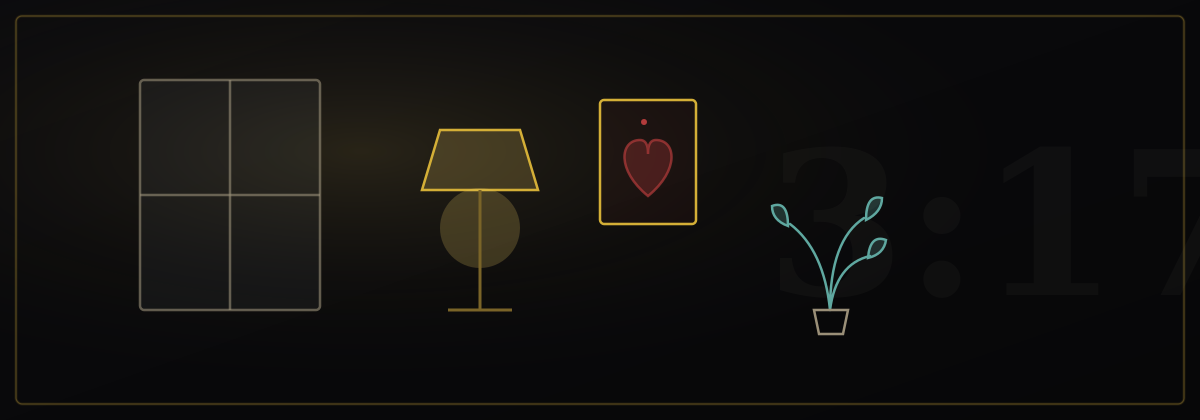
Alina D’Souza is twenty-four. She has lived in Apartment 504 for three weeks, long enough for the flat to begin carrying evidence of her. Her shoes sit unevenly on the metal rack by the door. A tote bag from work rests on the couch, still holding two receipts, a lipstick without its cap and a packet of almonds she has forgotten exists. A half-dead money plant leans toward the window with stubborn optimism. A framed print waits behind the couch because she hasn’t decided where to hang it.
Above her bed hangs the Sacred Heart of Jesus, the faded print her mother insisted she bring from Goa, with a tiny red bulb beneath it that Alina rarely switches on.
These details matter to me more than any monster. They are what make a life feel lived in. Alina eats noodles straight out of the pan after a disastrous day at work. She leaves a yellow lamp on so the flat won’t feel empty when she returns. She answers her mother’s “Reached home?” with a promise to call tomorrow. She stays up far too late watching strangers organise their refrigerators.
Horror is most frightening when it lands on someone ordinary, because we can’t keep our distance. We don’t think, “I would never go into that house.” We think, “That’s my bedroom. That’s my phone. That’s my Thursday night.”
Making Alina ordinary also gave me room for a different kind of courage, one that doesn’t look like heroism. She has no weapon and no plan. What she has is her best friend Karena, who answers on the fourth ring; her faith and her family; and a very human stubbornness about holding on to her own life.
I didn’t want a hero. I wanted a woman you might recognise in the lift of your own building. That, I think, is what makes what happens to her so hard to shake off.
● Coming soon
3:17 is coming soon. Follow @rheaa_noor on Instagram for the release date.
↑ Back to top
3:17
Apartment 504: Why the Scariest Place I Could Imagine Was an Ordinary Mumbai Flat
Finding horror in the familiar.
A haunted mansion lets you tell yourself you would never go inside. An ordinary apartment building gives you no such comfort.
When I began writing 3:17, I knew it couldn’t take place in a crumbling haveli or a lonely hill-station bungalow. Those places are frightening, but they are also far away. I wanted horror that could follow readers home.
So I gave it an address that could belong to any of us: an ageing residential building in Andheri West, squeezed between a pharmacy and a row of shops whose signboards have faded under years of monsoon rain. It has no name worth remembering, just a blue board with its number, half-hidden behind electrical wires and a bougainvillea that grows wherever it pleases. The broker called it peaceful. Alina understood that to mean old.
Every detail of that building is deliberately familiar. The lift has a folding metal gate and complains every time it passes the third floor. The corridor lights work whenever someone remembers to report them. The paint outside the flats is peeling near the skirting, exposing older coats beneath it like layers of forgotten skin. Someone has left a garbage bag outside their door, right beside the notice forbidding it. Downstairs, the watchman dozes over a silent cricket highlight on his phone.
If you have lived in Mumbai, you have probably lived in this building, visited a friend in it, or waited too long for its lift.
Then there is the city itself. Mumbai never truly sleeps. It merely changes its breathing. By day it shouts: trains, horns, vendors, drills. At night it softens without ever falling silent. A cab passes the signal. A shutter scrapes down somewhere. A dog barks twice and is answered from another lane. From the fifth floor, those sounds arrive muted and detached, as though they belong to another city running beneath the one you live in.
That is where 3:17 lives: in the gap between a city that is always awake and a single bedroom where, for a few minutes after three in the morning, no one else is.
What I wanted most was to show how little it takes. A tube light flickering outside Apartment 503. One drip from the kitchen tap. A lamp that was on when you fell asleep and isn’t any more. Nothing dramatic. Just the familiar becoming slightly, unbearably wrong.
You can walk away from a haunted mansion. It is much harder to walk away from home.
● Coming soon
3:17 is coming soon. Follow @rheaa_noor on Instagram for the release date.
↑ Back to top
3:17
Why 3:17 A.M. Is Such a Terrifying Time to Wake Up
The hour when an ordinary room can suddenly feel wrong.
You wake up. The room is dark. You reach for your phone. 3:17 a.m.
Almost everyone knows this moment. Nothing you can name has woken you: no alarm, no sound, no dream you remember. You are simply awake, in the deepest part of the night, and the room doesn’t look quite the way it did when you closed your eyes.
There is something uniquely vulnerable about that hour. It is too late to call it night and too early to call it morning. The city outside has gone as quiet as it ever gets. Everyone you love is asleep. If something felt wrong, who would you even tell?
At that hour, the mind behaves differently. The fan sounds louder. The half-open door seems wider. The clothes on the chair take on a shape. You know, rationally, that nothing has changed. You lie very still anyway, listening.
And notice what we do first: we reach for the phone. We look to that small glowing screen for reassurance, for the time, a notification, proof that the world is still there. It is the one thing that is supposed to tell us exactly where we are.
The idea for this book arrived in exactly that moment. One night, unable to sleep, I found myself staring at the time glowing on my phone. An ordinary hour. An ordinary room. An ordinary silence. Then a thought appeared: what if your phone knew something you didn’t?
In the novel, Alina D’Souza begins losing time at 3:17. She falls asleep scrolling and wakes with the phone already in her hand, open to a chat she doesn’t remember opening. The screen says it is 3:17. Something else tells her she isn’t alone. And when she checks the details afterwards, the timestamps refuse to add up.
That hour works so well for horror because it sits right on the border between sleeping and waking. Did it really happen, or did you dream it? Did you send that message, or did someone else? At 3:17, you can’t be sure, and uncertainty is where fear grows best.
There is a reason the book is called 3:17 and not 3 a.m. Three o’clock is a mood. 3:17 is an appointment.
So the next time you wake in the dark and reach for your phone, glance at the time and hope it says something else.
● Coming soon
3:17 is coming soon. And if you ever receive a message at 3:17 a.m.… don’t answer it.
↑ Back to top